
Order management
for every channel.
An OMS should do more than move orders. It should protect your margins. Configurable order-fill logic, RFID-accurate stock, and a single view of your fulfillment nodes.
She wants the coat in a medium, and this store is out. The associate finds one at another store and ships it to her house, with tax worked out for her address before she pays.
What Ship from Store did in its first fourteen weeks.
One enterprise retailer turned on Ship from Store, opening their store stock to online demand. These are their own numbers, measured from go-live.
A six-figure incremental revenue contribution across the first 14 weeks. Store stock became sellable to online customers, so orders that would have been turned away on warehouse stock constraints were fulfilled from the shop floor instead.
Figures reported by a Teamwork Commerce customer following their Ship from Store rollout on Teamwork OMS. Retailer anonymized.
Every order, routed by your rules.
Rank your fill strategies once and the engine applies them to every order: stock depth, node capacity, and the business rules you set by store, channel or SKU. It holds at scale, 100K+ orders a day, built for Black Friday and game-day peaks.
- Order-fill logic configured by store, channel or SKU
- Rank fill strategies by stock depth and node capacity: your priorities, in the order you set them
- Store pick-up, ship-to-store, and vendor drop-ship, all configurable in the rule stack
- Safety stock per location, so a popular line is held back for the shop floor instead of being sold out from under it online
Routing runs on live stock, not last night's file.
Every fill decision reads the same stock record the store is selling from, updated as it happens rather than imported overnight. Where a retailer runs RFID, the counts behind that record are verified to 99.9% accuracy, but the OMS does not require it.
- Every order promise made against the live stock record, not an overnight snapshot
- Warehouse-to-store transfers tracked end to end, by EPC where RFID is in use
- One real-time view across stores, warehouses, transit, and suppliers
- RFID is optional: where it is deployed, cycle counts take minutes rather than days
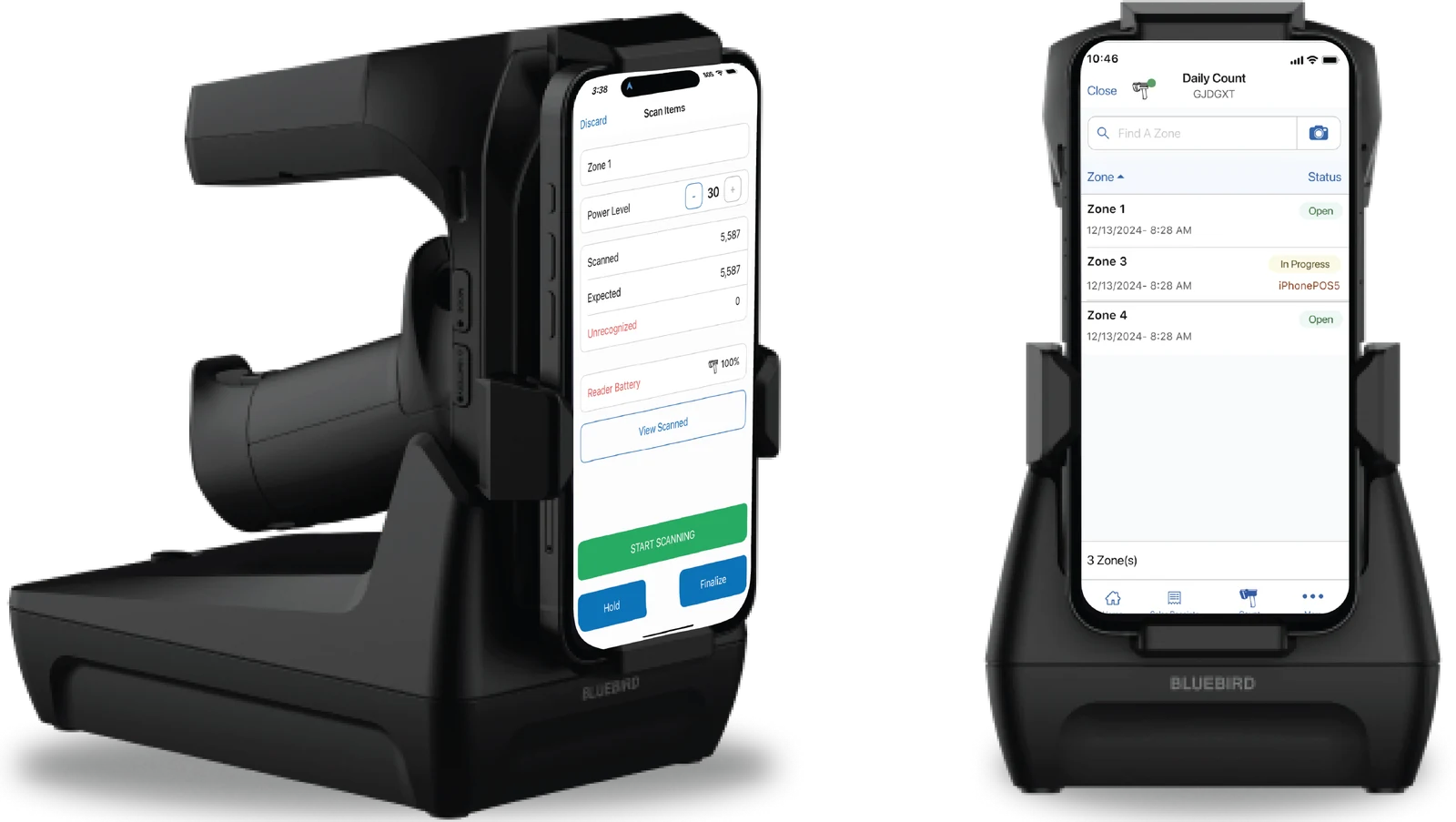
Every fulfillment workflow the business runs.
Click-to-ship, cross-channel returns and the scenarios in between, running natively on the same POS, inventory and RFID.
Ship-from-Store
Every store a fulfillment node: pick, pack, and ship from the mobile POS.
BOPIS & Click-and-Collect
Pickup promised against the live stock record, so the item is there when the customer arrives.
Endless Aisle
The size is not in this store. The associate sells it anyway, from wherever it is held, shipped straight to the customer rather than into the store and out again.
Split shipments
One order drawing on store, warehouse and supplier, split across them but kept under a single order ID.
Cross-channel returns (BORIS)
Buy online, return in store, back on the shelf and sellable instantly.
Multi-entity and multi-currency
Orders across legal entities and currencies, with the data handed to the ERP that closes the books.
Museums & non-profits
Gift shop, membership and donations on one record, with multi-location gift-shop inventory.
Replenishment triggers
A location is replenished once the item sells or falls below the limit you set for it.
What happens when an order lands?
Three taps on the device already in their hand, between a customer walking in and a parcel going out.
The order lands on the floor device as a notification, not in a back-office queue.
A pick list against RFID-verified stock, so the unit is on the shelf rather than assumed to be.
14 Ellis Court, London
Carrier label from the device, and the order closes without anyone opening a laptop.
Illustrations of the flow. Ask for a walkthrough to see it on a live device.
Real-time global inventory lookup
An enterprise search showing stock broken down by location group, with live on-hand, committed, and available-to-sell figures.
Send sale & customer orders
Ship to the customer's home or schedule a pickup at another store, with tax calculated in real time against the destination jurisdiction.
Incoming & outgoing queues
Dedicated modules alert the team to outstanding omnichannel tickets, and staff pick, pack, or reject each one with a reason code.
Carrier labels on the device
Out-of-the-box shipping integration, ShippyPro connecting to carriers such as FedEx, returns the tracking number and prints the label from the device.
In-store pickup
Collection status tracked per order, with custom instructions, an alternate designated collector, and on-screen signature capture.
Same-day delivery
Direct integrations with DoorDash and Uber, giving associates line-level visibility into driver notifications, timing, and customer tips.
SOC 2, PCI DSS and GDPR compliant.
Independently verified against the standards your security, finance, and legal teams demand, in the markets we serve.
Bring your security questionnaire SOC 1 Type 2
 SOC 2 Type 2
 GDPR
GDPR PCI DSS
 NF525 / TSE
 ISO 27001
 MLPS 2.0 · China












Order management questions, answered.
Teamwork's OMS is natively integrated with POS and Inventory rather than bolted on through middleware, so order-fill decisions read the same live stock record the store is selling from. You configure the fill logic yourself, ranking strategies by stock depth and node capacity and setting rules by store, region, channel or SKU, and safety stock per location holds a popular line back for the shop floor. Where a retailer runs RFID, the counts behind that record are verified to 99.9% accuracy.
Order Fill Logic is a ranked, configurable rule stack. You set the priority, for example fill complete from the highest-stock location, ship-to-store for pickup orders, or ship-from-vendor, and the engine applies your rules to every order against live stock. It can also split an order across nodes when a single location cannot fill it. It does not rate-shop carriers or route by distance, and it does not calculate margin.
Yes. Ship-from-store turns every retail location into a fulfillment node with pick-and-pack tasks for store associates. BOPIS (Buy Online Pick Up In Store) promises against the live stock record rather than an overnight file, so the item is there when the customer arrives. Buy Online Return In Store (BORIS) is also natively supported.
Yes. The OMS operates across multiple legal entities and currencies, and a US-based HQ can manage global operations while regional teams work in their local currency and language. Fiscal compliance itself sits with the POS and with the ERP: the OMS hands the order, tender and stock movement across so the books are closed in the system that owns them.
Stop routing orders blind.
See how configurable order-fill logic on RFID-verified inventory protects your margins.